Working Papers
Asset Pricing with the Awareness of New Risks
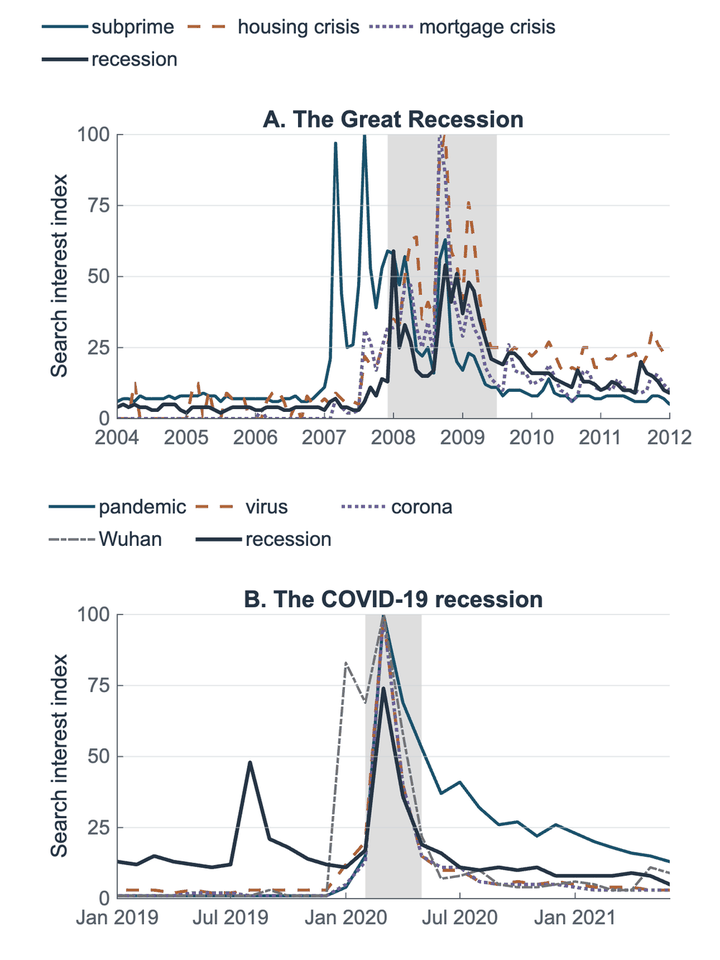
Crises often begin with the awareness of a new aggregate risk whose severity is not yet known. We develop an equilibrium model in which investors learn that severity from realized output, and show that this learning explains how returns, volatility, and valuations evolve around U.S. recessions.
Highlights:
- Around U.S. recessions, output follows a U-shaped path, realized excess returns dip and then rebound, return volatility peaks several months after onset, and valuations bottom out before recovering.
- Professional forecasters revise their forecasts for the same quarter downward as a recession unfolds, yet remain too optimistic on average: the severity of a downturn becomes apparent only gradually.
- In our model, a new risk arrives, its effects on output build and then recede, and investors learn its severity from realized outcomes.
- Early in severe recessions, outcomes are worse than investors expect: disappointments raise risk aversion and lower valuations, while expected excess returns are negative.
- The model generates S-shaped expected returns, hump-shaped return volatility, and deeper valuation declines in severe recessions.
- Calibrated only to macroeconomic and unconditional asset-pricing moments, the model matches the untargeted paths of returns, volatility, and valuations around recessions.
Presentations: WFA 2026, 2025 Annual Conference of the Swiss Society for Financial Market Research*, EFA 2024, EasternFA 2024, CUHK-RAPS-RCFS 2024, NFA 2024, CICF 2024, 8th Young Scholars Finance Consortium, MFA 2024, FIRS 2023, 6th World Symposium on Investment Research, 30th Finance Forum, University of British Columbia, Texas A&M University, University of Iowa
Learning about Expected Profitability
Investors learn about the persistent drivers of firm profitability from firms' and their peers' earnings. We measure each firm's belief and the uncertainty around it from accounting data alone, and show that these belief revisions predict stock returns.
Highlights:
- A structural learning model delivers, in real time and without price-based signals, each firm's belief about the driver of its profitability and the investor's remaining uncertainty about it.
- By Bayes' rule, the same news moves the belief about an uncertain firm more. Investors who learn the news with a delay respond to the news itself, so the belief revision scaled by uncertainty predicts returns.
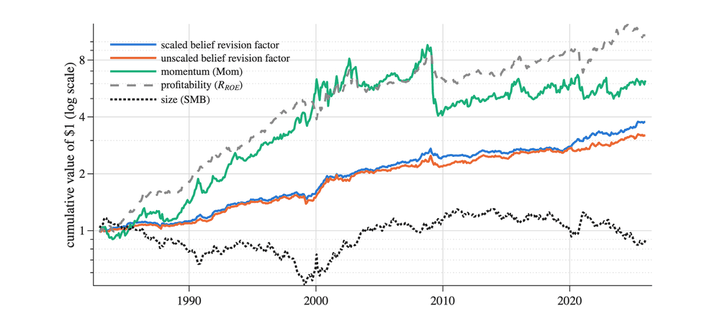
- A size-neutral factor on the scaled belief revision earns 0.26% per month (t = 5.4) over 1983 to 2025, an annualized Sharpe ratio of 0.85, with alphas of 0.17 to 0.24% against standard factor models.
- In a Bayesian factor comparison, it has a posterior inclusion probability of 0.93, against 0.33 for the unscaled revision and less than 0.30 for factors on the level of profitability.
- The premium is not the drift after earnings surprises: most of the news behind it is about the profitability of a firm's peers, which is priced over the following months.
Presentations: Silicon Prairie Finance Conference 2026 (Best Paper Award), Alpine Finance Summit 2026, CICF 2026, EasternFA 2026, BI Norwegian Business School, University of Iowa
Effects of Financial Speculation on Households
Financial speculation is often blamed for hurting ordinary savers. We study households that stay out of the stock market while speculators trade on disagreement about future cash flows, and find that exclusion from the equity premium, not speculation, is what limits their wealth.
Highlights:
- In an overlapping-generations economy, speculators disagree about expected output growth and trade in the stock market, while households save only in the risk-free asset.
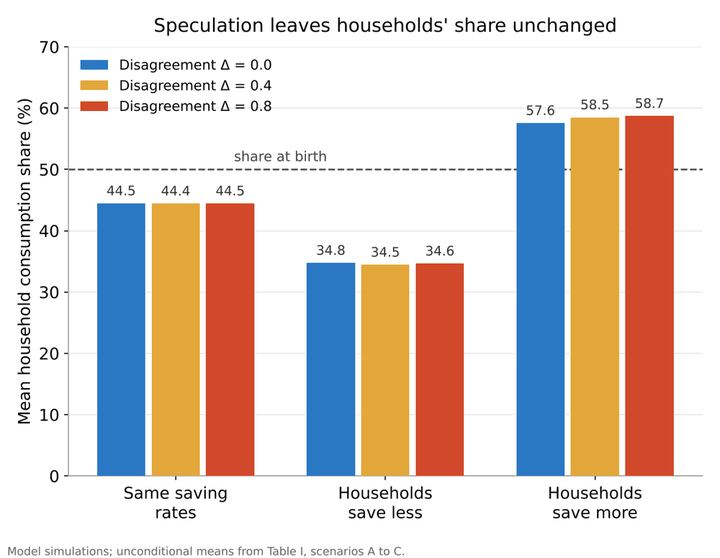
- Households forgo the equity premium, which lowers their consumption share: starting from 50%, it settles around 45% in the baseline even without speculation.
- Speculation raises asset price volatility and makes speculators' consumption shares fluctuate widely, but it changes neither the mean nor the volatility of households' consumption share.
- Speculation reaches households only through the equity premium: when optimistic speculators save more, high disagreement raises the equity premium to 2% and stock market volatility to 17%, and the household share falls.
- Broadening access to the stock market does more to reduce wealth inequality than restricting speculation.
Presentations: London School of Economics (Joint Risk & Stochastics and Financial Mathematics Seminar), Carnegie Mellon University, Texas A&M University, University of Iowa
The Response of Equity Yields to a Long-Run Shock
We study how a well-identified long-run growth shock moves the equity term structure. A positive shock steepens the equity yield curve by raising expected dividend growth, especially at short maturities, while leaving discount rates largely unchanged.
Highlights:
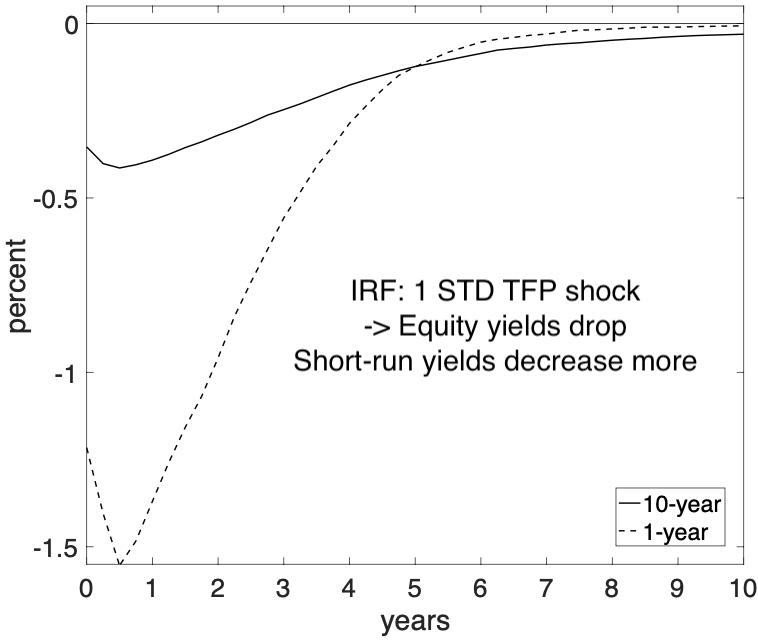
- Using the TFP news shock of Kurmann and Otrok (2013) and synthetic equity yields from Giglio et al. (2024), a positive long-run shock lowers the equity yield curve and steepens it: the 10-1 year slope rises by about 1 percentage point.
- The response comes from expected dividend growth, which rises most for short-term claims, while the risk premium components barely move. Shocks to expected consumption growth give similar results.
- Firms finance the resulting investment mainly with new issuance: cash dividends rise slightly while total payout falls, so net repurchases drop.
- Growth-firm yields respond two to three times more strongly than value-firm yields, reflecting larger changes in expected dividend growth.
- The production-based model of Ai et al. (2018), modified to separate cash dividends from total payout, matches these responses better than benchmark equity term structure models.
Presentations: CICF 2024, 2024 Annual Conference of the Swiss Society for Financial Market Research, EasternFA 2024, University of Iowa, 2023 Econometrics Mini Conference
Uninformed yet Consequential: Liquidity Shocks in FX Markets
Uninformed order flow is valuable to dealers because it can be internalized against offsetting customer trades. We study the limits of internalization and show that uninformed liquidity shocks that do not net out within dealers' client books move exchange rates, even though they carry no information.
Highlights:
- In a two-tier model of FX intermediation, dealers cannot neutralize such shocks with their customers, because attracting offsetting flow requires moving quotes away from fair value. They hedge the residual imbalance in the inter-dealer market, where intermediaries require compensation for inventory risk.
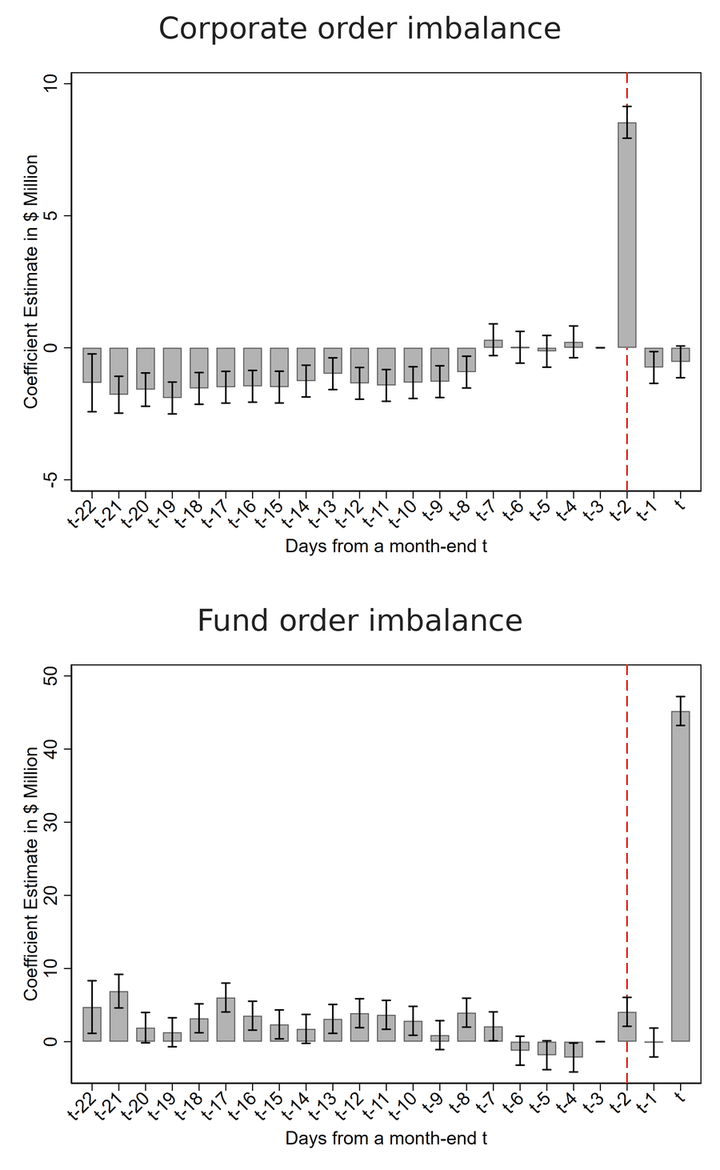
- Using hourly sector-level FX spot data from CLS, covering about 22% of global spot turnover, we identify corporate liquidity shocks with month-end settlement breaks, which shift the timing of corporate trades for cash-flow reasons unrelated to information.
- During settlement breaks, hourly corporate order imbalance rises to a multiple of its usual level, and fund flows do not offset it.
- A doubling of the corporate order imbalance raises inter-dealer volume by 15 to 25% and realized volatility by 9 to 15% of their hourly averages.
- The volatility effect disappears for pegged currencies and around the 4pm WMR fix, where inventory risk is low.
Presentations: WFA 2022, 2023 AFFECT Mentoring Workshop, 17th Central Bank Conference on the Microstructure of Financial Markets, 4th Future of Financial Information Conference, University of Iowa, University of Missouri, 2021 FMA New Ideas Session
Recession Fear and the Price of Cash-flow Risk
When do investors demand the most compensation for cash-flow risk? I show that the premium for payout cash-flow risk rises with professional forecasters' fear of recession, rather than with realized consumption or a habit state.
Highlights:
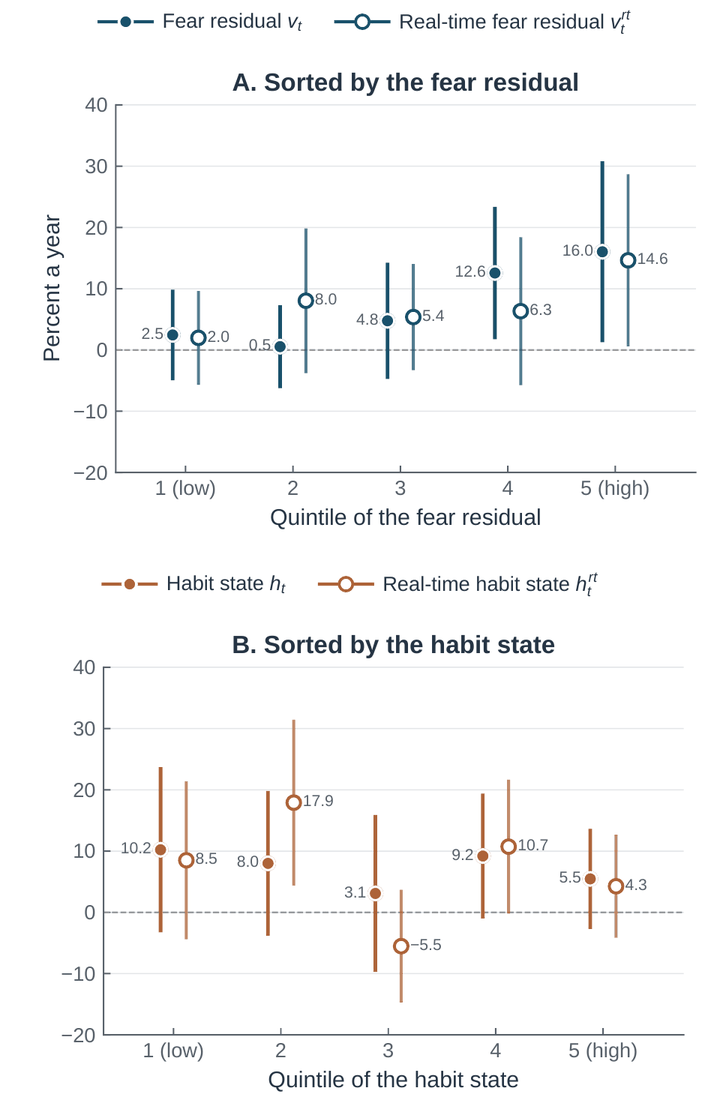
- I measure recession fear with the Survey of Professional Forecasters' average probability of a decline in real GDP in each of the next four quarters. Realized consumption, a habit state and unemployment explain only 12% of its variance.
- Stocks whose payouts (dividends plus repurchases) covary most with consumption earn 7.2% a year more than stocks whose payouts covary least.
- This spread rises by 0.7 percentage points a month per standard deviation of fear that realized conditions do not explain, while the habit state has no comparable effect over the full sample.
- High fear also predicts a lower value premium, which supports fear acting on discount rates rather than through overly pessimistic cash-flow expectations.
Presentations: MFA 2021, Oxford Finance Job Market Workshop 2019, 31st AFBC, 9th FMCG, EFMA 2018, Macquarie University, University of Iowa, Melbourne University, Aarhus University, NOVA University, Vrije University, University of Sydney